View this article in Arabic (AR)
United Arab Emirates
The United Arab Emirates: A Fascinating Destination for Travelers
The United Arab Emirates (UAE) is a country in the Middle East that consists of seven emirates: Abu Dhabi, Dubai, Sharjah, Ajman, Umm Al Quwain, Ras Al Khaimah, and Fujairah.
The UAE is known for its rich cultural heritage, modern architecture, diverse landscapes, and popular tourist attractions that welcome visitors from around the world.
This article explores some of the most famous tourist destinations in the UAE, along with information about the country’s history, population, economy, and cultural significance.
Flag of the United Arab Emirates, Currency, Population, Tourism, Landmarks
Download the application  Flags Of World - Quiz ,
And test your knowledge with Flags of World ,
History of the United Arab Emirates
The United Arab Emirates has a long and diverse history that dates back thousands of years. Archaeological discoveries show that the region was home to several ancient cultures and trading communities.
The area was influenced by different civilizations and regional powers over time, including Arab, Persian, and other neighboring cultures that contributed to the region’s historical development.
From the 7th century, the region became part of the Islamic world and developed important trade routes across the Arabian Gulf.
Between the 16th and 20th centuries, the area experienced periods of Portuguese and British influence before the formation of the modern state.
The United Arab Emirates gained independence in 1971 following a series of agreements with the United Kingdom. The country then formed a federation of seven emirates, each governed by its own ruler.
Since its formation, the UAE has developed into a modern country with a strong economy, advanced infrastructure, and an important role in regional and international affairs.
Capital of the United Arab Emirates
The capital of the United Arab Emirates is Abu Dhabi, which is also the largest emirate in terms of land area and one of the most populous.
Abu Dhabi is located on a T-shaped island in the Arabian Gulf and covers an area of approximately 67,340 square kilometers.
The city serves as the political, economic, and cultural center of the UAE and is home to many government institutions, diplomatic missions, and international organizations.
Abu Dhabi is also a major tourist destination, offering a wide range of attractions such as the Sheikh Zayed Grand Mosque, the Louvre Abu Dhabi, the Emirates Palace, Yas Island, and Ferrari World.
📊 United Arab Emirates Population Now (September 30, 2025) – Updated Daily Statistics
How many people live in United Arab Emirates today? and what is the current population of United Arab Emirates as of September 30, 2025?
According to the latest official statistics and United Nations data, the estimated population of United Arab Emirates as of September 30, 2025 is approximately 11,409,599 people.
📈 Daily Change
Based on daily statistics, data shows The population increased by 721 people compared to yesterday September 29, 2025, when the population was 11,408,878 people.
🗓️ Population Data Updates
The population figures presented in this article for United Arab Emirates were last refreshed on September 30, 2025. This update applies only to the statistical data provided, while the rest of the article content may not change as frequently. For continuously updated demographic information and global rankings, please visit our World Population Updates section.
Frequently Asked Questions ❓
How many people are currently living in United Arab Emirates according to the latest real-time estimates?
As of today September 30, 2025, the population of United Arab Emirates is estimated to be around 11,409,599 people according to the most recent statistics.
👉 Discover more country facts — including population, capital, currency, language, geography, and more — in our World Countries Facts & FAQs section.
🌍 Explore More
For more information, you can visit the World Population Ranking by Country Live Page to see real-time population updates for the world and all countries, including rankings by population size, lists of the top 10 fastest-growing and least-growing countries, and projections of population until 2050.
👉 Want to explore more? Visit our World Countries and Cities Hub for population data, capitals, flags, and cultural insights of every country.
🏛️ In addition to population statistics, you can also explore our World Country Capitals section , where you will find detailed articles about the capital city of each country, including history, culture, and key facts.
📌 Population Summary
In summary, the population of United Arab Emirates as of September 30, 2025, is approximately 11,409,599 people. These numbers are based on the latest official statistics and daily demographic updates. For more details about United Arab Emirates and other nations worldwide, make sure to explore our dedicated country sections listed above.
United Arab Emirates Flag Meaning
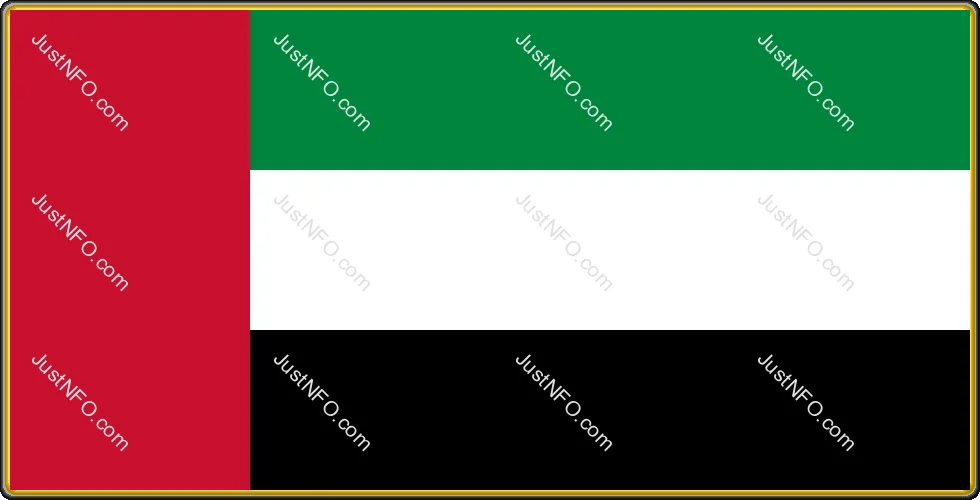
The UAE flag was adopted on December 2, 1971, the same day the country was formed as a federation of seven emirates.
The flag consists of four colors: red, green, white, and black. It features a vertical red stripe on the hoist side, along with three horizontal stripes of green, white, and black.
Each color of the UAE flag carries symbolic meaning that reflects the country’s identity, values, and heritage.
Red represents courage and the sacrifices made in the process of building the nation.
Green symbolizes growth, prosperity, and the Islamic heritage of the country.
White represents peace and honesty, while black reflects strength and dignity.
Flag of the United Arab Emirates, Currency, Population, Tourism, Landmarks
Download the application Flags Of World - Quiz ,
And test your knowledge with Flags of World ,
Location of the United Arab Emirates
The United Arab Emirates is located in Asia, specifically in the region of Western Asia, commonly known as the Middle East.
It shares land borders with Saudi Arabia to the south and west, and Oman to the east and southeast, while the northern coastline lies along the Arabian Gulf.
The UAE covers a total land area of approximately 83,600 square kilometers and has a coastline of about 1,318 kilometers.
Its strategic location near the Strait of Hormuz makes it an important hub for global maritime trade and energy transportation.
The country features a diverse geography that includes deserts, mountain ranges, coastal areas, islands, and natural oases.
United Arab Emirates Economy
The United Arab Emirates has a highly developed and diversified economy and is among the largest economies in the world, according to the International Monetary Fund.
The country has a nominal GDP of approximately $421.1 billion and a per capita GDP of around $43,103.
The UAE operates a market-based economy supported by several key sectors, including oil and gas, trade, tourism, finance, construction, and manufacturing.
Oil and gas remain important components of the UAE economy. The country holds significant proven oil and natural gas reserves and is a member of the Organization of the Petroleum Exporting Countries (OPEC) and the Gulf Cooperation Council (GCC).
The UAE maintains strong trade and investment relationships with many countries, especially China, India, United States, Japan, and the European Union.
Tourism also plays a major role in the economy, with millions of international visitors arriving each year to explore its cities, attractions, and cultural landmarks.
In addition, the UAE has developed into a regional financial hub, hosting major institutions such as the Abu Dhabi Securities Exchange, the Dubai Financial Market, and Nasdaq Dubai.
United Arab Emirates Currency
The official currency of the United Arab Emirates is the United Arab Emirates dirham, abbreviated as AED.
The dirham is divided into 100 fils. As of November 20, 2023, the exchange rate is approximately 1 US dollar = 3.67 AED.
The dirham was introduced in 1973, replacing the Qatar and Dubai riyal as well as the Bahraini dinar in some regions.
The currency is issued by the Central Bank of the UAE and features the portrait of Sheikh Zayed bin Sultan Al Nahyan, the founding father of the UAE, on the obverse side.
The reverse side of the banknotes includes various landmarks and symbols representing the heritage and development of the country.
The dirham is available in banknotes of 5, 10, 20, 50, 100, 200, 500, and 1000 AED, as well as coins in denominations of 1, 5, 10, 25, and 50 fils, and 1 AED.
United Arab Emirates Country Code
The country code of the United Arab Emirates is +971, which is used for making international phone calls to the country.
For landline numbers, certain emirates use specific area codes, such as 2 for Abu Dhabi, 4 for Dubai, and 6 for Sharjah. These are followed by a local number to complete the call.
A typical landline number format in the UAE appears as +971 4 123 4567, depending on the emirate and service provider.
Mobile numbers in the UAE begin with specific prefixes such as 50, 52, 54, 55, 56, and 58, which indicate different mobile network operators.
A standard mobile number format looks like +971 50 123 4567.
Flag of the United Arab Emirates, Currency, Population, Tourism, Landmarks
Download the application Flags Of World - Quiz ,
And test your knowledge with Flags of World ,
United Arab Emirates Pronunciation
The pronunciation of “United Arab Emirates” in English is commonly represented as [juːˌnaɪtɪd ˌærəb ˈɛmɪrɪts].
The phrase can be broken down phonetically as follows:
- [juː] as in “you”
- [ˌnaɪtɪd] as in “night-ed”
- [ˌærəb] as in “Arab”
- [ˈɛmɪrɪts] as in “Emirates”
The country is also commonly referred to as “the Emirates”, pronounced as [ɪˈmɪrɪts].
- [ɪ] as in “it”
- [ˈmɪr] as in “mir”
- [ɪts] as in “its”
United Arab Emirates Abbreviation
The abbreviation for the United Arab Emirates is UAE, which stands for United Arab Emirates.
It is written in capital letters without periods or spaces between the letters.
“UAE” is commonly used in writing and speech to refer to the country and is often combined with other terms such as UAE culture, UAE flag, and UAE currency.
United Arab Emirates Culture
The United Arab Emirates has a rich and diverse culture that reflects its Islamic heritage, Arab identity, and modern cosmopolitan society.
The culture of the UAE is characterized by values such as hospitality, tolerance, generosity, respect, and modesty.
It is shaped by the country’s history, geography, and environment, as well as the diverse nationalities and communities living in the UAE.
Key aspects of UAE culture include language, traditions, customs, and social practices.
Language
The official language of the United Arab Emirates is Arabic, which is widely spoken across the country and used in government, education, media, and religious contexts.
English is also widely used, along with several other languages spoken by expatriate communities, including Hindi, Urdu, Persian, Malayalam, and Tagalog.
Major Cities in the United Arab Emirates
The United Arab Emirates is home to several major cities, each with its own economic, cultural, and historical significance.
Dubai
Dubai is the most populous and well-known city in the UAE and one of the world’s leading global cities.
Located on the coast of the Arabian Gulf, it has a population of approximately 3.4 million people.
Dubai is known for its innovation, modern development, and tourism industry, and features landmarks such as the Burj Khalifa, Palm Jumeirah, Dubai Mall, and Dubai Frame.
Abu Dhabi
Abu Dhabi is the capital of the UAE and the largest emirate by land area, serving as the political and administrative center of the country.
It is located on an island in the Arabian Gulf and has a population of around 1.5 million people.
The city is known for its cultural landmarks and major attractions such as the Sheikh Zayed Grand Mosque, Louvre Abu Dhabi, Emirates Palace, and Yas Island.
Sharjah
Sharjah is the third-largest emirate in the UAE and is widely recognized for its cultural and educational significance.
It is known for its museums, festivals, and heritage sites, including Al Qasba, Sharjah Art Museum, Sharjah Aquarium, and the Heritage Area.
Ajman
Ajman is the smallest emirate in the UAE by area and population, located along the Arabian Gulf coastline.
It is known for its growing economy, education sector, and local attractions such as Ajman Museum, Ajman Corniche, and Ajman University.
Flag of the United Arab Emirates, Currency, Population, Tourism, Landmarks
Download the application Flags Of World - Quiz ,
And test your knowledge with Flags of World ,
Major Landmarks in the United Arab Emirates
The United Arab Emirates is home to some of the world’s most iconic landmarks, known for their architectural innovation, cultural importance, and tourism appeal.
Burj Khalifa
The Burj Khalifa in Dubai is the tallest building in the world, standing at a height of 828 meters with 163 floors.
It is a global architectural landmark featuring observation decks, fountains, luxury hotels, and surrounding parks.
Sheikh Zayed Grand Mosque
Located in Abu Dhabi, the Sheikh Zayed Grand Mosque is one of the largest mosques in the world, capable of accommodating up to 40,000 worshippers.
It is known for its Islamic architectural design, including large domes, chandeliers, intricate carpets, and landscaped courtyards.
Palm Jumeirah
Palm Jumeirah is an artificial island in Dubai designed in the shape of a palm tree, extending into the Arabian Gulf.
It is a luxury destination featuring hotels, villas, resorts, shopping areas, and beaches.
Al Ain Oasis
Al Ain Oasis is a UNESCO World Heritage Site located in Al Ain and is home to over 147,000 date palms.
It is known for its ancient irrigation systems, agricultural landscape, and cultural heritage significance.
Beaches in the United Arab Emirates
The United Arab Emirates is home to many beautiful beaches along the Arabian Gulf and the Gulf of Oman, offering both public and private coastal destinations.
Jumeirah Beach
Jumeirah Beach in Dubai is one of the most popular beaches in the UAE, stretching along the Arabian Gulf for approximately 18 kilometers.
It is a public beach offering activities such as swimming, sunbathing, jet skiing, parasailing, camel riding, and surfing.
The beach is located near major attractions such as Burj Al Arab, Jumeirah Mosque, Wild Wadi Water Park, and Madinat Jumeirah.
Saadiyat Beach
Saadiyat Beach is a scenic beach located on Saadiyat Island in Abu Dhabi, known for its natural beauty and clean environment.
It includes private access areas with facilities such as loungers, umbrellas, restaurants, and changing rooms.
The beach is also known for its natural ecosystem, including sightings of dolphins, turtles, and various bird species.
Khor Fakkan Beach
Khor Fakkan Beach is located on the east coast of the UAE in Sharjah, overlooking the Gulf of Oman.
It is a public beach known for water activities such as snorkeling, diving, fishing, boating, and hiking.
The area is surrounded by natural attractions such as Al Wurayah Waterfall, Shark Island, Khor Fakkan Fort, and Al Hayl Castle.
Flag of the United Arab Emirates, Currency, Population, Tourism, Landmarks
Download the application Flags Of World - Quiz ,
And test your knowledge with Flags of World ,